Effective mycotoxin management requires more than rumen detoxification
By Dr Mohammed Amine Hachemi
Mycotoxins are secondary metabolites produced by fungi that commonly contaminate feed ingredients used in dairy production, including grains, forages, silages, and by-products. At levels below the legal guidance levels, these contaminants can negatively impact feed intake, milk production, immune function, rumen function, and reproductive performance.
Ruminants are often considered more resilient than monogastric animals because the rumen microbiota can transform or partially degrade certain mycotoxins. However, rumen detoxification is variable and is not always complete. In some cases, mycotoxins or their metabolites may remain biologically active, while chronic exposure can also disturb rumen microbial populations and fermentation patterns. As a result, mycotoxins can compromise nutrient utilization, animal health, production efficiency, and overall profitability in dairy systems.
17.11.2026
Share this post
✅ Link copied to clipboard!
Why modern dairy cows remain vulnerable to mycotoxins
Modern high-producing dairy cows remain vulnerable to mycotoxin challenges despite the natural protective role of the rumen. This is because dairy cows consume complex diets composed of forages, silages, concentrates, and feed by-products, each of which can contribute different mycotoxin risks. As a result, dairy cows are often exposed not to a single toxin, but to a broad spectrum of commonly encountered and emerging mycotoxins, often at subclinical levels and in combination. The rumen is an important first line of defense because rumen microorganisms can transform or partially degrade certain mycotoxins. However, this protection is not complete. The efficiency of rumen detoxification depends on the type of mycotoxin, level and duration of exposure, rumen microbial composition, rumen pH, diet formulation, and digesta passage rate. When the rumen detoxification capacity is exceeded or when degradation is incomplete, mycotoxins may escape the rumen and reach the lower gastrointestinal tract. Moreover, rumen metabolism does not always mean detoxification. Some microbial transformations can produce metabolites that retain biological activity and can still exert negative effects on the animal. Therefore, the rumen should be viewed as a partial protective barrier rather than a complete detoxification system. These limitations are exacerbated in high-producing dairy cows. Increased feed intake and faster digesta passage rates can reduce the time available for microbial degradation. At the same time, cows in early lactation, under heat stress, or experiencing metabolic pressure may be less able to compensate for the additional burden created by mycotoxins. Under these conditions, mycotoxins can contribute to impaired rumen function, reduced nutrient utilization, increased liver and immune stress, decreased reproductive efficiency, and inconsistent milk performance.
Overall, mycotoxin risk in dairy cows should not be evaluated only by toxin concentration in the feed. It should also consider diet complexity, rumen function, production level, physiological stress, and the cow’s capacity to maintain resilience under chronic exposure.
Mitigating mycotoxin impact: evidence from a dairy cow trial
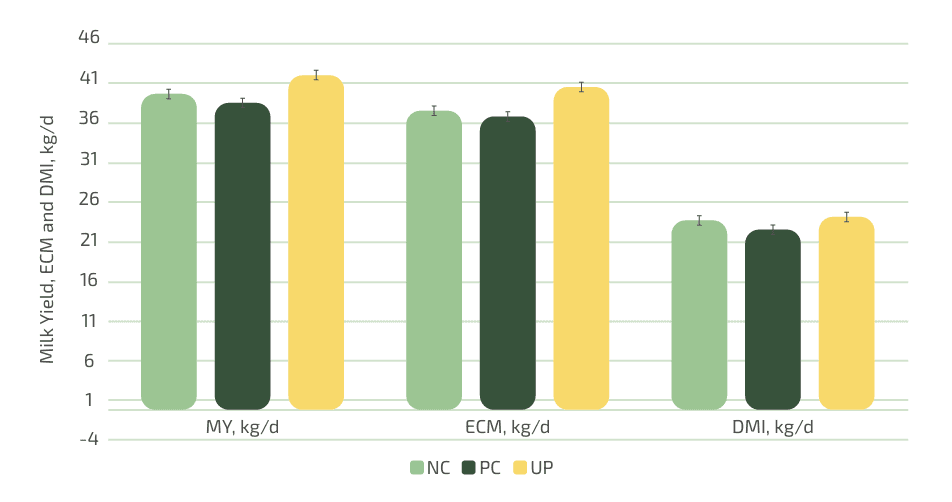
To evaluate the practical value of mycotoxin mitigation, a controlled study was conducted at the University of New Hampshire using lactating Holstein cows. The objective was to assess whether supplementation with a mycotoxin deactivator (UniKe Plus) could reduce the negative effects of a naturally contaminated diet on feed intake and milk production. The study included 24 cows over a 6-week period. Cows were fed either a naturally low-mycotoxin control diet, a naturally contaminated diet containing multiple mycotoxins, or the same contaminated diet supplemented with UniKe Plus. Performance responses, including dry matter intake and milk yield, were monitored throughout the trial. The natural contaminated diet reflected a field-relevant co-contamination scenario and contained multiple mycotoxins, including FUM, ZEA, and DON. Compared with cows fed the low-mycotoxin control diet, cows fed the highly contaminated diet showed a reduction in performance. On average over the final three weeks of the study, cows fed the highly contaminated diet had a reduction in dry matter intake (DMI) of 1.3 kg/day and produced 1.0 kg/day less milk and 0.8 kg/day less energy-corrected milk (ECM). These results indicate that naturally occurring mycotoxin co-contamination, even under practical feeding conditions, can negatively affect intake and milk performance. (Figure 1). However, supplementation of UniKe Plus markedly improved animal performance. Averaged over the final three weeks of the study, DMI increased by 1.5 kg/day compared with cows receiving the contaminated diet without supplementation and the supplemented cows produced 3.4 kg/day more milk and 3.8 kg/day more ECM. Notably, supplemented cows also exceeded the performance of cows fed the low-mycotoxin control diet, producing 2.4 kg/day more milk and 3.0 kg/day more ECM. Overall, these findings indicate that effective mycotoxin mitigation can alleviate the negative effects of naturally occurring mycotoxins and support improved productive performance (Figure 1). The improvement in dry matter intake and milk output suggests that UniKe Plus helped reduce the biological burden associated with mycotoxin exposure, allowing cows to better maintain feed consumption, nutrient utilization, and productive efficiency.
Figure 1: Estimated average milk yield (MY), energy-corrected milk (ECM), and dry matter intake (DMI) during the final three weeks of the 6-week experimental period in dairy cows fed a naturally low-mycotoxin-contaminated diet (NC), a naturally high-mycotoxin-contaminated diet (PC), or the high-mycotoxin diet supplemented with Unike Plus (UP). Values are expressed as kg/cow per day.
Proactive mycotoxin management: safeguarding dairy cow performance and health
The positive response observed with UniKe Plus may be explained by its multimodal mode of action. Rather than relying on a single mechanism, the solution combines several complementary ingredients designed to reduce mycotoxin exposure and support the animal’s ability to cope with mycotoxin-induced stress. These mechanisms include mycotoxin adsorption, support for rumen microbial activity and biotransformation, and reinforcement of animal resilience through antioxidants and plant-derived compounds. This multimodal approach is particularly relevant under field conditions, where dairy cows are commonly exposed to multiple mycotoxins simultaneously. While some mycotoxins can be partially adsorbed, Fusarium mycotoxins such as DON, FUM, and ZEA are generally more difficult to bind consistently. Therefore, mitigation strategies based only on adsorption may not provide sufficient protection. In this context, components that support rumen microbial function, promote the biotransformation of mycotoxins, and help the animal manage oxidative, inflammatory, hepatic, and gastrointestinal stress, which may contribute meaningfully to maintaining performance. Overall, the results demonstrate that naturally occurring mycotoxins can compromise dairy cow health and performance, even at concentrations below or within current regulatory guidance levels. They also reinforce an important concept: ruminal degradation provides partial protection, but it should not be considered a complete defense system, particularly in modern high-producing dairy systems with high dry matter intake, faster digesta passage, and elevated metabolic demand. However, effective mycotoxin management requires more than the application of a feed additive to mitigate mycotoxin. A robust strategy should be proactive, integrated, and risk-based, combining contamination prediction, regular feed analysis, proper storage practices, risk assessment, and the use of scientifically validated mitigation solutions. This approach allows producers to identify risk earlier, interpret analytical results more effectively, and apply the appropriate level of protection based on the contamination profile and animal sensitivity.
In this context, Adisseo has developed a science-based mycotoxin management program designed to help dairy producers anticipate contamination risks and reduce the impact of mycotoxins on animal health and performance. At the heart of this program is Mycoman, a digital platform that centralizes data, monitors contamination levels, and supports informed decision-making. Based on these insights, Adisseo provides a comprehensive Mycotoxin Management line with targeted solutions tailored to each situation.
Toxy-Nil is designed for low-risk mycotoxin scenarios while UniKe and UniKe Plus are designed for broader risk management and enhanced protection. Together, these solutions help safeguard feed quality and support animal performance. Together, Mycoman and the Mycotoxin Management range deliver a complete mycotoxin management program, covering every step from risk anticipation, contamination monitoring, to effective animal protection, helping producers translate analytical data into practical actions that protect herd health, productivity, and farm profitability.
In conclusion, while the rumen represents an important first line of defense, it cannot be relied upon as the sole mechanism for mycotoxin protection. Modern dairy systems require a broader strategy that combines prevention, monitoring, and mitigation. Advances in feed additives, such as multi-functional mycotoxin deactivators, offer practical and effective tools to reduce risk and improve resilience, helping dairy producers safeguard performance, health, and economic return under real-world mycotoxin pressure.
Enter your email address
Please enter your email address to access all content and download it with one login.
Related solutions
Product names and availability may vary by region, please contact your local Adisseo representative for more information.
Toxy-Nil
Toxy-Nil is a reliable protection against moderate-level mycotoxin contamination.